

CARINA Environmental Assessment Report: Context-Specific Strategies for Bio-Based Value Chains
.
RSB’s research demonstrates how integrated sustainability frameworks deliver both scientific rigour and practical implementation pathways
The transition to a sustainable bioeconomy faces a fundamental challenge: how do we assess whether bio-based alternatives genuinely deliver environmental benefits across their entire value chain?
Carbon metrics alone don’t tell the full story. A feedstock that shows promise in one agricultural system may create consequences in another. And crucially, how do we move beyond academic assessment to create actionable pathways for implementation?
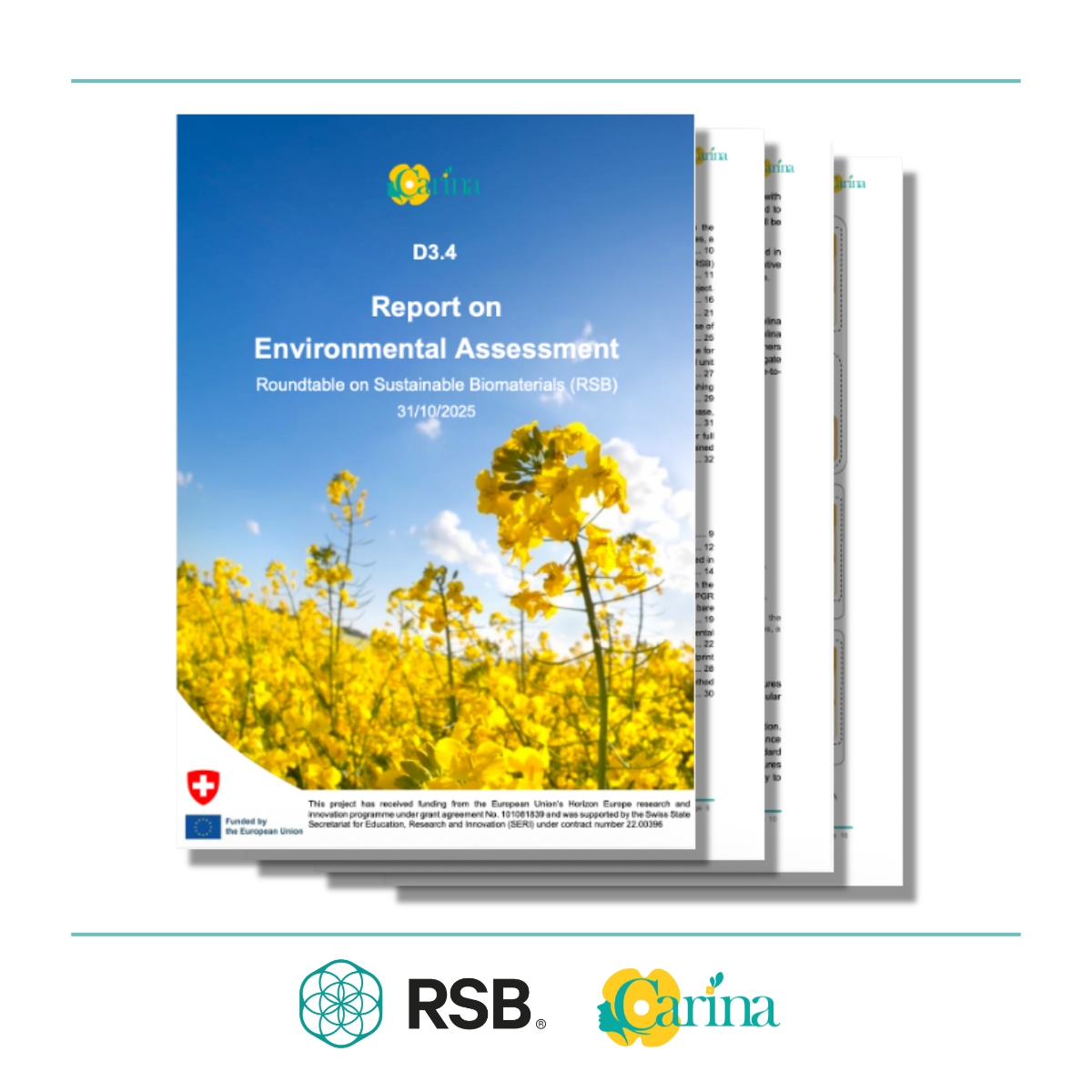
RSB’s D3.4 Environmental Assessment Report for the CARINA project addresses these questions, revealing that context-specific strategies are essential for sustainable bioeconomy development. The CARINA project is supported by the European Union within the framework of the Horizon Europe programme, bringing together leading European research institutions and industry partners.
The findings challenge simplistic assumptions and demonstrate why robust sustainability assessment requires both scientific depth and practical frameworks.
.
An Integrated Research Approach
.
The research demonstrates how integrating Life Cycle Assessment (LCA) with the RSB Principles & Criteria framework creates a more complete sustainability picture.
LCA evaluates environmental impacts across a product’s entire lifecycle—from raw material extraction through production, use, and disposal. It quantifies greenhouse gas (GHG) emissions, water consumption, land use, and energy demand.
The RSB Principles & Criteria provide a complementary framework addressing environmental, social, and economic dimensions. Where LCA focuses on quantifiable environmental metrics, RSB’s framework encompasses human rights, labour conditions, local food security, community impacts, and biodiversity conservation.
Combining these methodologies creates dual capability: LCA’s quantitative rigour paired with RSB’s multidimensional scope.
The CARINA research focused on camelina (Camelina sativa), an oilseed crop gaining attention as a feedstock for bio-based products. The assessment examined camelina cultivation on marginal land, understood as agricultural areas with lower productivity that may not compete directly with food production.
The research employed an iterative methodology, allowing findings from one phase to inform subsequent analysis and identify intervention points throughout the value chain.
.
Three Critical Findings
.
- Marginal Land Viability Depends on System Integration
The research confirms that camelina on marginal land can deliver environmental benefits; however, success depends entirely on its integration within existing agricultural systems.
Lower yields on marginal land are an expected trade-off. The critical question becomes whether reduced productivity undermines overall sustainability performance, or whether other factors, (such asavoiding food crop competition and utilising underutilised land) create net benefits.
The findings show that when camelina cultivation fits strategically within regional agricultural patterns, lower yields don’t negate environmental advantages. However, this requires careful site selection, appropriate agronomic practices, and realistic production expectations.
This context-dependency challenges universal solutions in sustainable bioeconomy development. A feedstock succeeds or fails based on local conditions, existing infrastructure, farming practices, and regional agricultural economics.
The research provides evidence for policymakers and industry leaders: the concept holds promise, but implementation requires rigorous site-specific assessment rather than blanket assumptions.
- Fertilisation Practices Emerge as Major Environmental Hotspot
The LCA identified fertilisation practices as a significant environmental hotspot in camelina production systems.
This finding points to a specific, actionable intervention point. Manufacturing synthetic fertilisers requires significant energy input, application leads to GHG emissions through soil processes, and excess fertilisation contributes to water pollution through nutrient runoff.
For camelina systems specifically, optimising fertiliser use becomes critical to overall sustainability performance. The research suggests that bio-based value chains built on camelina feedstock must prioritise precision agriculture approaches, improved nutrient management, and potentially alternative fertilisation strategies.
Industry stakeholders developing camelina-based products now have clear guidance on where to focus improvement efforts. Agricultural advisors and policymakers can direct support toward practices addressing this identified hotspot.
- Same Feedstock, Different Outcomes: Context Matters
The most significant finding confirms what many sustainability practitioners suspected: the same feedstock produces dramatically different sustainability outcomes depending on integration within agricultural systems and regional contexts.
Two camelina production systems using identical genetics can deliver vastly different environmental profiles based on factors like crop rotation patterns, regional climate conditions, infrastructure availability, local agricultural practices, soil conditions, and market access.
This context-dependency has profound implications for bioeconomy policy and business strategy. Standardised approaches will consistently underperform compared to strategies adapted to local conditions.
For sustainability assessment methodologies, this reinforces the need for frameworks that accommodate regional variation while maintaining rigorous standards. The RSB approach combinesquantitative LCA with principles-based assessment adapted to local contexts, constituting an effective path forward.
.
.
RSB bridge between Research and Practice
.
This work exemplifies RSB’s approach to bioeconomy development: combining scientific assessment with practical implementation frameworks.
By integrating LCA with the RSB Principles & Criteria, the research delivers both quantitative environmental metrics and assessment of broader sustainability dimensions including social and economic factors.
RSB’s framework, developed through multi-stakeholder processes and refined over 18 years, provides the practical implementation component. While LCA identifies environmental impacts, RSB’s principles address how to achieve sustainability across diverse contexts and regions.
The CARINA research demonstrates this integration in action, delivering findings that are both scientifically rigorous and immediately applicable to policy, industry, and agricultural decisions.
.
Looking Forward
.
The D3.4 Environmental Assessment Report represents one deliverable within the broader CARINA project research programme. Forthcoming work includes D3.5, which will further develop understanding of sustainability pathways for bio-based value chains.
The findings also point toward future research needs. Understanding how context-specific factors affect sustainability outcomes requires ongoing investigation across different feedstocks, production systems, and regional conditions.
As the bioeconomy scales, the need for robust sustainability assessment combining scientific rigour with practical applicability will only intensify.
Click here to access the full D3.4 Environmental Assessment Report.
Contact RSB about research collaboration.
Explore RSB’s other research and development projects.
.
.
.
.
.