European Expertise: RSB’s role as an R&D Partner in EU Horizon Projects
.
As the world transitions to a bio-based and circular economy, RSB works to ensure that this shift safeguards both social and environmental integrity. A key aspect of this work is RSB’s participation in multiple EU Horizon projects, where it provides sustainability expertise to support industry, policy, and innovation.
.
RSB & Horizon Europe
Horizon Europe is the EU’s key funding programme for research and innovation. As an R&D partner, RSB provides science-based solutions for hard-to-abate sectors, ensuring that innovations align with robust sustainability principles. By leveraging its certification framework, stakeholder convening power, and technical expertise, RSB bridges research, policy, and industry practice, ensuring sustainability remains central to innovation.
In particular, RSB has established itself as a key enabler in R&D projects by:
Guiding sustainable design – Developing roadmaps, gap analyses, and guidelines based on RSB’s Principles & Criteria (P&C).
Assessing environmental impact – Applying Life Cycle Assessments (LCA) and GHG calculations to evaluate novel production pathways.
Advancing standardisation – Supporting certification of emerging feedstocks and industrial processes to ensure compliance with rigorous sustainability benchmarks.
Contributing to policy & stakeholder engagement – Bringing together industry leaders, NGOs, and policymakers to shape sustainability frameworks.
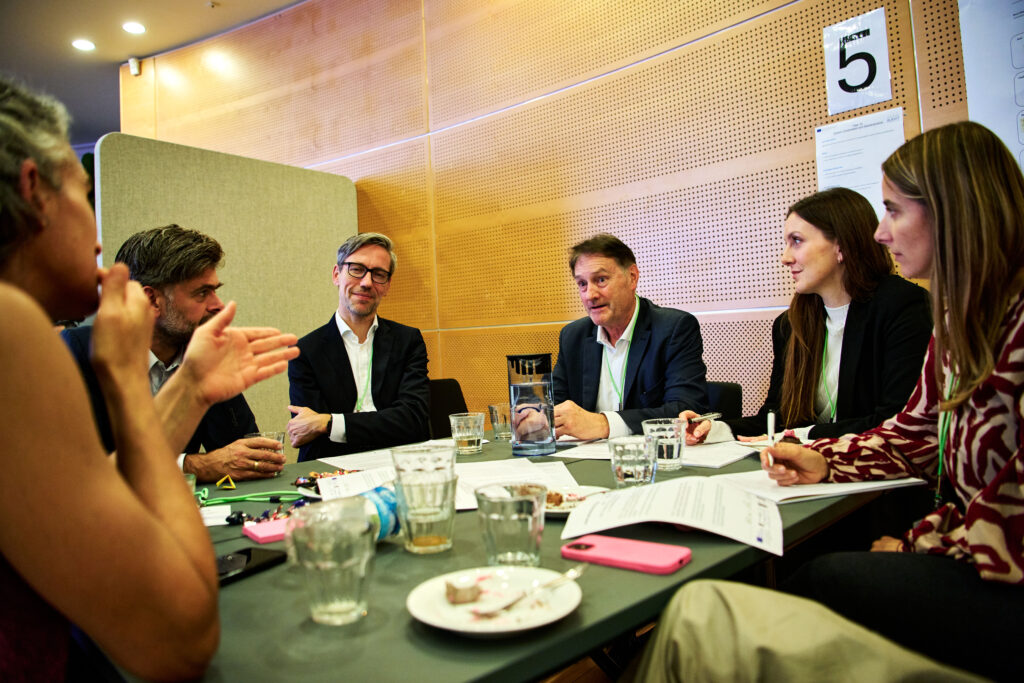
RSB’s EU Projects Lead Blanca de Ulibarri at the Bold Vision for Airports in 2050 workshop with ALIGHT project partners.
.
.
Highlights from 2024
Throughout last year, RSB engaged in multiple collaborative events that fostered dialogue among stakeholders in the bioeconomy. These engagements demonstrate RSB’s commitment to working at the nexus of policy, industry, and innovation, ensuring that sustainability principles guide the development of bioeconomy solutions. See below for some highlights of activities in 2024.
.
ALIGHT
In 2024, RSB played a critical role in the ALIGHT Project’s efforts to integrate sustainability into airport operations and the broader aviation sector.
Earlier in the year, RSB participated in a General Assembly meeting at Vilnius International Airport in Lithuania, which highlighted sustainable aviation fuels (SAF) adoption as a cornerstone of sustainable aviation. Later in the year, RSB took part in the “SAF: Time for take-off” conference in Athens, where RSB’s engagement focused on bridging policy and practice by providing expertise on its certification framework. This underscored RSB’s role in aligning supply chains with stringent sustainability standards, paving the way for practical and scalable SAF integration in airports. Then, at the end of the year, RSB provided further contributions at the “Bold Vision for Airports in 2050” workshop, sharing in its expertise on SAF, Non-CO2 effects and circular economy principles, emphasising the importance of robust sustainability frameworks to achieve long-term environmental goals.
ICARUS
As a critical player in the ICARUS project, RSB has actively been contributing to important discussions on SAF since joining this project.
In mid-2024, ICARUS hosted events throughout Europe but also in globally to foster international cooperation in SAF development. In Brazil, RSB’s contribution at the “International R&I Cooperation on Sustainable Aviation Fuels” workshop, as part of the BBEST & IEA Bioenergy Conference, was instrumental in arguing that any developments regarding SAF should employ its globally recognised sustainability certification framework, which provides a trusted basis for verifying the environmental and social benefits of SAF. Once again, these sessions underscored RSB’s leadership in enabling the scalability and credibility of SAF production, a cornerstone of sustainable aviation.
CARINA
In early 2024, RSB contributed to the CARINA project’s efforts to harness camelina and carinata as sustainable feedstocks for biofuel production – exploring these crops’ potential to deliver high yields while improving soil health and promoting rural development.
Field trips near Thessaloniki in Greece provided project partners with some hands-on insight into the innovative cropping systems and demonstrated the potential of grounding these innovative agricultural systems in RSB’s Principles & Criteria. RSB supported the project further by providing critical input on integrating the highest of sustainability standards and criteria into the production and supply chain, ensuring that the resulting biofuels meet rigorous environmental and social benchmarks. RSB also participated in November in the Living Labs meetings from Spain and Italy, where it was discussed how to align certification with innovative cropping systems from CARINA project. Audience from these meetings were farmers and research entities linked to camelina and carinata crops. This collaboration highlighted the importance of connecting agricultural innovation with sustainability certifications to ensure long-term viability and acceptance.
STAR4BBS
By establishing robust sustainability metrics for bio-based sectors, RSB has contributed significantly to the STAR4BBS project’s aim of maximising the potential of sustainability certification schemes and labels to support a successful transition to a sustainable bio-based economy.
As an early RSB participant in the pilot test of the project’s Biobased Monitoring System (BMT), RSB engaged in numerous internal workshops and strategy sessions throughout the year. With the RSB Advanced Product Standard selected as one of the test cases for developing BMT, RSB has played a big role in ensuring that STAR4BBS’s tools align with global sustainability standards. This eventually resulted in a report on sustainability indicators in mid-2024 that is now being incorporated into the BMT, which RSB had a significant role in. Later in the year, RSB was part of a workshop with policy makers from the European Commission and certification schemes to discuss the role of certification in upcoming legislation and policy instruments. Drawing from its expertise, RSB emphasised the need for harmonised sustainability indicators that address climate, biodiversity, and social equity impacts. This involvement underscores RSB’s role in shaping the frameworks that will define the future of the bioeconomy.
.
Turning vision into reality
By actively participating in workshops, providing sustainability guidance, and collaborating on actionable frameworks, RSB’s expert team ensures that the R&D work conducted on behalf of Horizon Europe is grounded in globally recognised sustainability principles. This practical approach will continue support project partners in navigating complex challenges and delivering impactful results.
For more information on RSB’s involvement in Horizon Europe projects, visit click here.